|
Posted: 08 May 2020 02:46 PM PDT
Focus Taiwan
Date: 05/08/2020 By: Kay Liu 
At the Fubon Guardians’ home venue in New Taipei.
Some of the soldiers carried a giant national flag, while several chemical corp. soldiers sang the national anthem. Taoyuan's home team, the Rakuten Monkeys, continued to place cardboard cutouts and mannequins in the empty stadiums, along with a band of drumming robots. [FULL STORY]  |
|
Posted: 08 May 2020 02:41 PM PDT
Taipei Times
Date: May 09, 2020 By: Staff writer, with CNA 
The outfield is pictured at the Yingfeng Cricket Ground in Taipei’s Songshan District yesterday.
Photo: Grant Dexter, Taipei Times The TCA Indians and FCC Formosans topped their groups in the first stage, which gave them direct entry to the semi-finals, which are to be played next week. The playoffs today are to begin with the ICCT Smashers, the Chiayi Swingers and PCCT United competing in Pool 1, while the Taiwan Dragons, the Hsinchu Titans and the Taiwan Daredevils are in Pool 2 tomorrow. The matches are at the Yingfeng Cricket Ground in Songshan District, with the first match of three starting at 11:30am each day. [FULL STORY]  |
|
Posted: 08 May 2020 02:37 PM PDT
Mobile World Live
Date: 08 MAY 2020  The three major mobile operators in Taiwan, Chunghwa Telecom; Taiwan Mobile; and Far EasTone, reported similar results for Q1 over the past week, with all suffering declines in mobile revenue and device sales, and taking initial steps to prepare for 5G launches later in the year. All three won 5G spectrum in three bands in an auction concluded in January, with their business plans approved by Taiwan’s National Communications Commission in late March. Chunghwa Telecom The operator led the market during Q1, with GSMA Intelligence figures showing it had a 34.3 per cent share by subscribers compared with around 25 per cent each for its two rivals. Mobile service revenue slid 3 per cent year-on-year to TWD14.3 billion ($477 million), which the operator credited to market competition and VoIP substitution. Device sales fell 15.6 per cent to TWD8 billion. It didn’t release ARPU figures. [FULL STORY]  |
|
Posted: 08 May 2020 02:33 PM PDT
High demand of electronic components lift export growth, dining industry still struggling
Taiwan News Date: 2020/05/08 By Chris Chang, Taiwan News, Staff Writer 
Electronic products, components still create momentum of Taiwan’s exports (CNA photo)
According to Taiwan's Ministry of Finance (MOF), the country's total exports in Q1 increased by 3.7 percent from last year, as a result of a 20 percent surge in electronic component exports alone. Meanwhile, imports shot up to 3.5 percent, mainly due to the high demand for manufacturing equipment and memory chips. Regarding trading partners, exports to the U.S. hit a historical high in Q1, with computers, disks, and Internet equipment making up the bulk of shipped goods. The sales of electronic components to Singapore turned a previous loss in exports to Southeast Asian countries over the past six quarters into a 5.6 percent increase. Because of the mixed demand for high-end technology, such as wafer testing and packaging, as well as raw materials for machines and plastic products, export growth to China was pegged at 6.7 percent. [FULL STORY]  |
|
Posted: 08 May 2020 02:29 PM PDT
Focus Taiwan
Date: 05/08/2020 By: Jeffrey Wu and Frances Huang  Taipei, May 8 (CNA) Acer Inc. and Asustek Computer Inc., the two leading PC brands in Taiwan, both reported on Friday an increase in sales for April due to more people working and learning remotely, which boosted demand for computer products, offsetting the economic impact from the COVID-19 pandemic. Acer said it posted NT$19.75 billion (US$661 million) in consolidated sales, up 41.1 percent from a year earlier, while Asustek announced its consolidated sales for the month rose 13.7 percent from a year earlier to NT$22.74 billion. In a statement, Acer said although the COVID-19 pandemic had forced many consumers to stay at home, the company benefited from solid demand because of an increase in online working and learning. Under such circumstances, Acer said sales of its Chromebook notebook computers rose 327.9 percent from a year earlier in April, while purchases of its ultrabook computers almost doubled last month. [FULL STORY]  |
|
Posted: 08 May 2020 02:26 PM PDT
SLUGGISH DEMAND: Mineral product shipments tumbled 63.2%, while exports of textiles fell 37.4% following the postponement and cancelation of sports events
Taipei Times Date: May 09, 2020 By: Crystal Hsu / Staff reporter The nation’s exports last month shrank 1.3 percent year-on-year to US$25.24 billion, the lowest since May 2017, as poor shipments of raw materials — due in part to price routs — more than eclipsed robust shipments of electronic components, the Ministry of Finance said yesterday. The retreat could worsen to between 4 percent and 6 percent this month as most global nonessential businesses are closed to help contain the COVID-19 pandemic, stalling trade activity, the ministry said. “Taiwan may feel a sharper pinch from the COVID-19 pandemic going forward, with downside risks looming larger than upside surprises,” Department of Statistics Director-General Beatrice Tsai (蔡美娜) told a media briefing in Taipei. Mineral product shipments tumbled 63.2 percent, the worst decline in history, as unprecedented shutdowns in Europe, the US and parts of Asia saw demand slump, Tsai said. [FULL STORY]  |
|
Posted: 08 May 2020 02:22 PM PDT
Radio Taiwan International
Date: 08 May, 2020 By: Leslie Liao 
The Legislature passed an additional NT$150 billion budget dedicated to COVID-19 relief
 |
|
Posted: 08 May 2020 02:18 PM PDT
France24 Television
Date: 08/05/2020 By::Marc Perelman Taiwan has some 440 confirmed cases of Covid-19 and so far only six deaths, despite being relatively close to the epicentre of the virus. Vice President Chen Chien-jen told FRANCE 24 his country had been able to control the pandemic because it took a very early decision to quarantine travellers from the Chinese city of Wuhan and quickly isolate and trace confirmed cases. He explained that this rapid reaction was a result of the experience of the SARS outbreak in 2003. Reacting to the Trump administration's claims that the virus had most likely originated at a laboratory in Wuhan – and not a seafood market as claimed by China – Chen said this theory could not be ruled out but that the only way to know was a thorough scientific probe. "The origin of the virus has to be examined scientifically and so far we can see that the virus originated from Wuhan. Whether it is from a laboratory or from the natural infection sources needs further confirmation," he said, adding that the laboratory theory was "one of the possibilities". He said that China clearly did not give the true figures of victims of the pandemic, saying that in the early stages, "only severe pneumonia cases were isolated and treated in hospital", thereby underestimating the real figures. [FULL STORY]  |
|
Posted: 08 May 2020 02:05 PM PDT
Focus Taiwan
Date: 05/08/2020 By: Emerson Lim 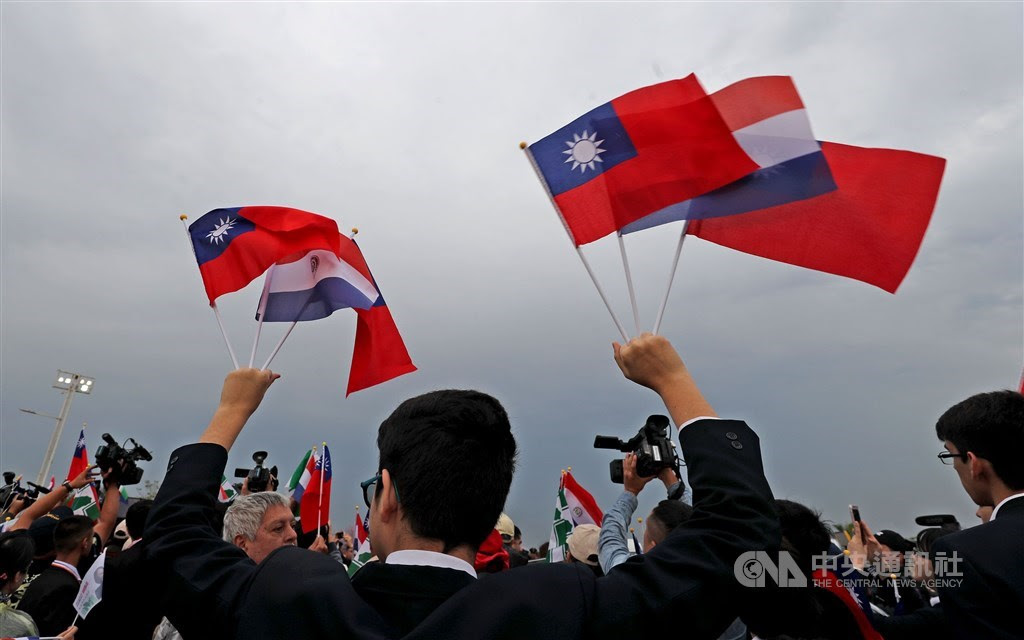
CNA file photo
According to the latest issue of Americas Quarterly, published on May 7, the Paraguayan Senate took a vote on April 17 in a virtual session on whether to urge the president to change diplomatic recognition from Taipei to Beijing. Confirming the report, MOFA spokeswoman Joanne Ou (歐江安) said seven Paraguayan senators associated with the left-leaning party caucus "Frente Guazú" petitioned on March 30 to establish formal ties with Beijing in exchange for medical supplies from China and direct access to China's market. The 45-seat Paraguayan Senate voted against the proposal, 25-16, on April 17, with four absent, Ou said in a statement, adding that the ministry is closely watching developments. [FULL STORY]  |
|
Posted: 08 May 2020 01:58 PM PDT
Taipei Times
Date: May 09, 20207 By: Wang Chun-chi and William Hetherington / Staff reporter, with staff writer 
A whale shark swims past a whale-watching boat off the coast of Hualien County in an undated photograph.
Photo courtesy of Turumoan Whale Watching and Water Entertainment Co The whale shark, along with the giant oceanic manta ray and the reef manta ray, were on Tuesday last week added to the list, making the disturbance, abuse, slaughter or capture of any of the three species punishable by up to five years in prison, and a fine of NT$300,000 to NT$1.5 million (US$10,033 to US$50,164), the council said. Whale sharks have been sighted in waters near Hualien for a few years now, and in March this year a roughly 6m whale shark swam into the Port of Hualien looking for food, it said. The capture of the three species has long been prohibited by stipulations in the Fisheries Act (漁業法), which require fishers to return the animals to the sea if accidentally caught, alive or dead, Hualien County Bureau of Agriculture Director Lo Wen-lung (羅文龍) said, but changes were made to enhance protection of the species by increasing the severity of punishments for offenders. [FULL STORY]  |
| You are subscribed to email updates from Eye On Taiwan. To stop receiving these emails, you may unsubscribe now. | Email delivery powered by Google |
| Google, 1600 Amphitheatre Parkway, Mountain View, CA 94043, United States | |


